Links

Friday, October 6, 2017

The Harvest of Colonialism in Cameroon

If history is not about the past but rather about the present which has been constructed by the past, then we are justified in claiming that the current strife going on in Cameroon is the harvest of the colonialism. This can be seen from different angles: first, the problem is defined culturally and linguistically as a problem of language and the marginalization of the Anglo-Saxon legacy in Southern Cameroons. Interestingly, the issue is not ethnic or "tribal", as African crises have been notoriously described in the past. The struggle seems to be about which colonial discourse to privilege rather than a clearer vision of the future of a people. The current crisis is a testament that colonial infrastructures have come to stay in Cameroon and that the way forward is negotiated only within the confines of this infrastructure. This shows a profound lack of imagination.

This is even more so given the attitude of Paul Biya's dictatorship towards the crisis. It has been handled in classically colonial manner through the use of violence. This is quite reminiscent of the violence meted out against those who fought against colonial violence during the heydays of independence struggle. Now the struggle is against the same colonial machinery with the only difference being that this machinery is masterminded by black pupils (Paul Biya's word) serving the interests of their masters in France. Compare this with the situation in Catalonia, Spain, where those seen to be leaders of a breakaway movement are taken to court and given due process, where no one was killed in the recent referendum that was outlawed by the state. Colonialism does not work through due process. Its aims can only be achieved through violence because its aims are rooted in illegitimacy and rapacity.

Thus, the so-called Anglophone problem in Cameroon is the harvest of colonialism in two ways. First, the crisis is located in duplicitous colonial discourse that denied the people of Southern Cameroons a right to self-determination and concocted the colonial state that is presently Cameroon. The rapacity of the postcolonial state forestalled any fruitful, imaginative insight that may maintain balance in said situation, exacerbating the fragility of the state. Perhaps a state that is built on duplicity cannot last. Second, the Anglophone problem is a harvest of colonialism because of the response of the Biya junta - through the characteristic violence copied from the colonial state. Instead of addressing the protests of the people through dialogue, the people are thrown in jail and massacred. The blatant disregard which colonial regimes demonstrated against Africans is now being mimicked by the Biya regime. Robin Kelley is therefore right to observe that "while colonialism in its formal sense might have been dismantled, the colonial state" is still with us. In Cameroon, we are fighting about how to live as colonial subjects: are we going to live as British or French? Is it possible to be free within the confines of colonial discourse and infrastructure? Let's see what happens in Cameroon.

Wednesday, September 20, 2017

2100 Days of Protesting Paul Biya's 34-Year Murderous Dictatorship in Cameroon

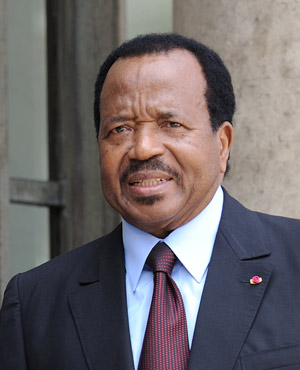
Preisdent Paul Biya (File: AFP)
Paul Biya of Cameroon (AFP)
Cameroon is a very small country in West-Central Africa and it may be best known for football (soccer) rather than much else. But the country has very talented and hardworking people who, but for their tenacity, would have been completely broken. Their hard work has however not paid off in the postcolony because the country is lead by a rapacious dictator who has been at the helm of the country for over 34 years now - Paul Biya. Under his regime, the country not only bowed to severe economic crisis which has killed many poor people, but the infrastructure of the country has far diminished. Cameroon is the site of ghastly rail and road accidents that are due to the dilapidated nature of the transportation system. The morality and morale of many people in the country have been almost destroyed as many young people do not appear to see a future for themselves in the country. The healthcare system is so broken that many women continue to die in childbirth and many people continue to die from little, curable diseases. Meanwhile, Paul Biya himself spends much of his time in France and other European countries, especially when he is sick, as he often does, given that is a very old man now.

The flashpoint in the country now is the Cameroon Anglophone crisis which Paul Biya has totally been unable to address. Schools have closed in Anglophone regions but Paul Biya has been busy cutting the Internet there rather than seeing to it that children go to school. Spreading illiteracy in Anglophone Cameroon seems to be Paul Biya's primary goal now, as he continues to serve the interest of France rather than Cameroonians. His focus on serving France rather than Cameroon has led some to say that he is actually a Frenchman rather than a Cameroonian.

We here at FlourishingAfrica have been protesting this rapacity for 2100 days since Paul Biya rigged the last election. We will continue to do so until he is no longer the dictator of Cameroon. The man is now washed up and has no new ideas about how to move the country forward. Cameroonians deserve much better.

Monday, July 31, 2017

Southern Cameroon Leaders Need Protest Imagination

Changing an entrenched political system with deep-seated, rhizomic national and international special interests, is always a long, hard, and bruising endeavor. In order to bring such change about, a group has to develop what I here call a protest imagination. A protest imagination is a way of perceiving the struggle for social and political transformation which begins from the premise that making such change is hard and takes a very long time. It therefore begins with a very long term vision and plan, studying and engaging in different means to effect the change sought. It was this very imagination which John Fru Ndi lacked when he thought that the change he sought in Cameroon could be achieved in a short time. When that did not happen, he became part of the government. The leadership (or should I say leaderships) of the Southern Cameroon struggles lacks this imagination and it does not bode well for the future of the movement. There is much tussling for turf and power in the groups but one hardly finds a long term vision and plan. Some of them think that this thing will be resolved in just a couple of years or even less. The idea that this may take ten to twenty years or even more is not part of their imagination. Their vision for the future of Southern Cameroons is even more fuzzy.

However, if one looks at any such struggles around the world, there is hardly any that has achieved its objects in just a few years. The struggles have often been protracted but means have been developed to always keep the struggle alive. People have planted crops, children have gone to school. hospitals have been built, people have bought and sold things: in all this, they have always known that they are in a struggle and the goal sought is always clear. I see South Africa as a good example of this. Life did not stop for Black people in South Africa because they were fighting against apartheid. The fight was carried out in the means of life. In fact, life was lived as a struggle until freedom was won.

The lack of protest imagination among Southern Cameroon leaders has led them to rely mainly on just a couple of tools, lacking vision as to how daily life may happen in the midst of seeking their vision. It is a deplorable state of affairs. The thought leaders of the movement have some hard thinking to do. 

Sunday, July 30, 2017

How Much Does a Human Soul Cost?

The annals of the transatlantic and trans-Saharan slave trades have inscriptions of the cost of a human being, such costs perhaps most often dependent on the health, age, race, and gender of the person. Perhaps such is still the case today in the illicit trade in human beings, especially women, around the world. However, I have hardly encountered the tabulation of the cost of selling a human soul. that animating force in the human being, which marks out the person as a conscious participant in things human and/or divine. While the cost of a human soul may perhaps be found in many places in life today, the place that seems more evident to me is the pay stub or pay slip. There, you will find how much our souls go for, for better or for worse.

As is the case with the illicit sale of the human body, the cost of the human soul also depends on age, race, health, and gender. Education has however come to play an especially significantly role, especially education in science and technology, which are seen as the drivers of the modern global political economy. So, depending on how much education you have and what you are educated in, the going price for selling your soul may be quite steep. As a CEO, for example, you have the chance of screwing the lives of many people, fighting to cut their health insurance and paying them $7.50 an hour. Or you may work at one of the many rapacious governments around the world, convincing people that red is blue and that bad policies are actually good for them. Out of no fault of yours, you may sell your soul to the CEO for $7.50, voting for the government that robs you of dignity just because, well, your reason is not quite clear.

You could be a preacher, saying that the human soul is priceless (remember Master Card?), yet putting yours at the service of white supremacy. You know very well that a black person's soul is worth less than a white person's soul and that the souls of women and LGBT people are worth less than those of straight white men, but you carry on . . . . There are things about the cost of the soul you simply know are right and one of those things is that all souls do not go for the same price. Or you may be an elitist preacher in the global South selling your soul and that of your congregants to the powers that be.

The causes we support in life and what we derive from them should tell us how much our souls are worth and what we think a human soul costs.

Wednesday, July 12, 2017

China's Empire Begins in Africa

China's global ambitions have been on display for a number of decades now but this has mainly been seen through its vast global economic investments. The pretense that China's global ambitions were limited to trade has been laid to rest today with the announcement of China's first military overseas base in Djibouti, a small piece of real estate in East Africa, where America also has a military base. 

Tuesday, June 27, 2017

To Hell With Authenticity!

I am sick and tired of reading books that talk about authentic this or authentic that - authentic human, authentic African, authentic Christian, etc. etc. They talk about authenticity as if they intend to hawk a particular kind of ware and are not sure if they will be trusted unless the ware is authentic. Why does it need to be authentic this or authentic that? Who creates such authenticity and what purpose does it serve? What does it mean to be authentically Christian or authentically human, or authentically African or authentically anything? We know what Mobutu Sese Seko did with the idea of African authenticity in the then Zaire. We know how talk of authenticity are often designed to exclude. The sooner we learn that there is no authenticity about any human artifact the better it will be for all of us. I do not want to read another book about what it means to be authentically African or authentically Christian or authentically anything. Just tell me what you are selling and I will know whether I want to buy it or not! 

Wednesday, June 14, 2017

Why Are Priests Turning Up Dead In Cameroon?

Just in the past two months, three Roman Catholic priests - one a bishop - have died in suspicious circumstances in Cameroon. One was found dead in his home while the other drowned in a river, purportedly leaving behind a suicide note. These deaths would raise suspicion even in normal circumstances. But the circumstances in Cameroon have been far from normal for a long while now. Priests and nuns have turned up dead in the country and others have even fled the country. This is why these recent deaths are raising many eyebrows. Will the answers to the many questions people are asking ever be found? What does the government know about these deaths?