Links

Friday, May 19, 2017

Emmanuel Macron Protects French Colonial Ties in Africa

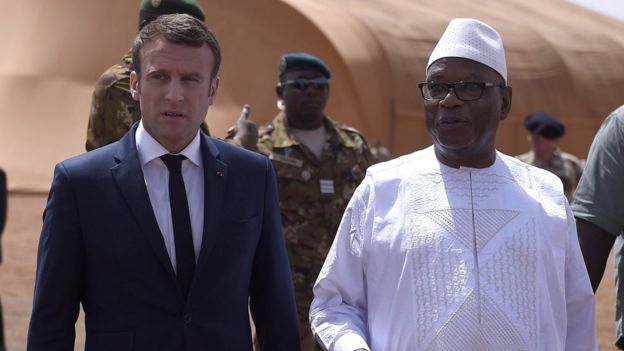
His first foreign trip after being sworn into office as France's president was to Europe's powerhouse, Germany. His second foreign trip took him not to Chine or the United States but to the African country of Mali, which is central to France's interest in Africa. The public narrative of this visit is that Macron is visiting French troops who are fighting terror in Africa. However, anyone who has been paying attention knows that France has enormous interest in Africa and this interest is more about economics than the military. Macron's trip is to protect the France-Afrique connection which is critical to France's economy. Africa is central to France's place as a world power because France still controls most of its former colonies there. Macron goes to protect these colonial ties.
French President Emmanuel Macron (L) talks with Mali's President Ibrahim Boubacar Keita (R) during a visit to the troops of France's Barkhane counter-terrorism operation in Africa's Sahel region in Gao, northern Mali, 19 May 2017
Emmanuel Macron and Mali's President Ibrahim Boubakar Keita


Source: BBC

Thursday, May 18, 2017

South African Men Shamed Into Action

The dire situation of violence against women in South Africa, made louder by the recent murder of Karabo Mokoena, has shamed some South African men to start taking action by organizing a march. The hashtage #NotInMyName is now trending on twitter and prominent figures are supporting the march.
A trending tweet
Source: BBC
But organizing marches should be only the first step. Deeper questions need to be asked about the kind of society that train men to be women-killers. And answers need to be sought for these questions. It is important to note that this disturbing trend of abuse and murder of women is not limited to South Africa. Societies all over Africa and indeed all over the world, need to be put on notice.

Saturday, May 13, 2017

South African Men as Savages: The Testimony of Pumza Fihlani

The recent murder of the young South African lady, Karabo Mokoena, has brought to the fore the violence that South African women and women around the world suffer at the hands of men - they are often not only harassed and humiliated but also disfigured and murdered. In the wake of the brutal murder of Mokoena, the BBC Johannesburg correspondent, Pumza Fihlani, has written a short but powerful cry for help. In the piece she portrays South African women as living in fear of their men who prowl, like savages, waiting to harm the suspicious woman at any time. Now we can say that painting all South African men as savages does them great injustice because there are surely some very decent men in South Africa. However, this would not do justice to the fear Ms. Fihlani manifests in her piece. A fearful person does not have time to discriminate between the good and the bad. The concern should be addressing the cause of the fear. South African men should be ashamed that their women live in such fear. This shame should spur them to do all that is in their power to restore safety to their communities because a society that kills its women is sure destined for extinction. Perhaps this is why some South African scholars have described the violence against women in that country as tantamount to signing a covenant with death.
Thursday, April 27, 2017

Monday, April 24, 2017

Science and Technology Evangelists Wanted in Africa


It is debatable what life in many African countries would be like if science and technology were as ubiquitously promoted as religion. While it is not certain what such a life may look like, one may hazard the suggestion that the ubiquitous promotion of science and technology in the continent may lead to improved medical care that would reduce deaths from curable health issues such as malaria, stem infant and maternal mortality, prolong life for the chronically ill, develop sustainable agriculture to address food shortages, and develop technology to address infrastructural needs, among many others. While some of the ills the continent faces today, such as political conflicts, may not be blamed on limited attention given to science and technology, there is no denying that significant emphasis still needs to be paid on science and technology in the continent.
            Instead of the development of science and technology, however, more attention is apparently being placed on the spread of religion in the continent. In addition to indigenous African religions, other religions around the world are keen on improving their stakes in the continent. Thus, religions, including Islam, Christianity, Judaism, Hinduism, Buddhism, Bahai, and others, are making the run in the continent. Recently it has been noted that about half the population of the continent is now Christian, with Pentecostalism becoming not only a churchly but also a societal phenomenon in many African countries. Islam, the second largest religion in the continent, is said growing by leaps and bounds, even as these religious are often appropriated within the framework of African indigenous religions.
            The fact that many Africans experience these other religions within the framework of their indigenous religions is significant because the quest for human well-being is central in indigenous religions, as would seem to be the case in all religions. This quest for human well-being makes indigenous religions to be quite amendable to scientific developments that address various human needs. Given that many of the difficulties the continent faces may be addressed through scientific and technological research, it would not be out of place to argue that such research would be welcome in many African countries. However, the establishment of such research facilities has been few and far between. Even as the educational infrastructures are struggling in many countries the churches and mosques and shrines are increasing. Thus, while religion, which Africans are said to be rich in, is increasing, science and technology, which many in the continent are in dire need of, do not appear to be experiencing significant boost.
            Why are the religions gaining ground in the continent while scientific and technological research hardly budge? Many reasons may be given for this but a very important one is that it is cheaper to promote religion than it is to promote science and technology. While enormous resources are needed to initiate and sustain a lab or research center, it costs less to start and sustain a religious community. With their limited resources, starting and sustaining a religious community has proven to be more viable. Thus, Jesus Christ and Karl Marx have been proven to be quite right when they noted that the poor rather than the rich are the target of religion. Because of the sheer cost of spreading science and technology, these are often ubiquitous in richer countries with significant resources while religions are often exported to poorer countries like those in Africa.
            Apart from the cost, however, the method of spreading religion and science and technology are quite similar: both require the evangelistic spirit because both seek to create and sustain converts. How this is so was especially evident during the so-called Scientific Revolution where an inventor like Robert Boyle needed to convince the wider public of the efficacy of his air-pump. This led to what Steven Shapin has described as the “populizarization of science.” We need science evangelists to popularize science and technology in Africa today. Perhaps those who popularize the various religions in Africa may also take up the cause of science and technology for, to misquote Jesus Christ, human beings do not live by the spirit alone.